Quick answer: Seat belts and head restraints do different jobs. The CDC says seat belts “reduce serious crash-related injuries and deaths by about half.” Head restraints help in rear crashes by keeping your head and torso moving together, which IIHS calls “the key to reducing whiplash injury risk.” A belt that fits right and a head restraint that sits high and close to the back of your head both matter.
Why do seat belts matter so much?
The CDC’s seat belt facts say “Wearing a seat belt is the most effective way to prevent injury or death in crashes for adults and older children,” and that seat belts “reduce serious crash-related injuries and deaths by about half.”
IIHS, a research group that studies vehicle safety, says on its seat belts page that “Seat belts are essential safety equipment.” It reports that using a lap and shoulder belt “reduces the risk of fatal injury by 60% in an SUV, van or pickup and by 45% in a car.” IIHS also explains that belts help keep people from hitting the inside of the vehicle and help prevent ejection.
The CDC adds that rear-seat passengers are less likely than front-seat passengers to wear a seat belt, and says to “Use a seat belt in the front and back seats on every trip, no matter how short.”
How should a seat belt fit?
Fit matters, and it matters for your neck too. IIHS says:
- “A properly fitted shoulder belt should lie snugly across the center of the chest and shoulder, not on the neck or face or falling off the shoulder.”
- “The lap belt should lie snugly across the upper thighs or low on the hips, not the belly.”
- “Pregnant drivers and passengers should place the lap belt low on the hips and under the belly.”
IIHS also notes that “any restraint is better than none at all.” If you are pregnant and have questions about comfort in the car, our post on massage during pregnancy covers the questions to bring to your obstetric provider.
Do air bags take the place of seat belts?
No. The CDC says “Air bags plus seat belts provide the greatest protection for adults.” Air bags are designed to work with belts, not instead of them.
What does a head restraint do in a rear crash?
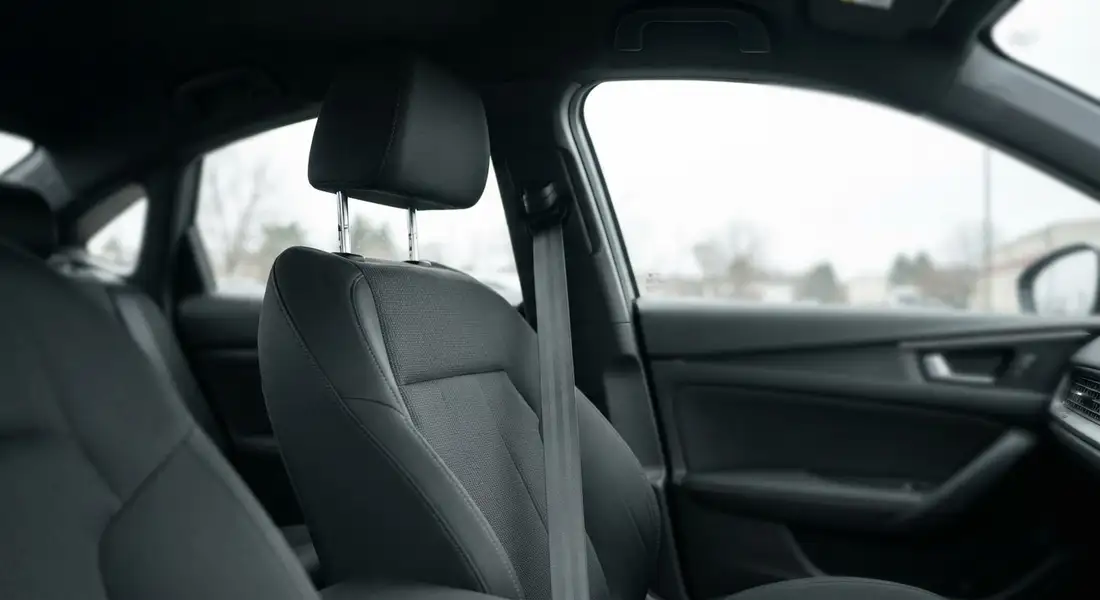
IIHS explains in its report on neck injury risk and head restraints that “When a vehicle is struck in the rear and driven forward, its seats accelerate occupants’ torsos forward.” Without support, “an occupant’s head will lag behind this forward torso movement.” That difference in motion between the head and the body is what strains the neck.
IIHS says “The key to reducing whiplash injury risk is to keep an occupant’s head and torso moving together,” and that “The higher and closer a restraint is, the more likely it will be to prevent neck injury in a rear collision.” The same report says the head restraint has to be “high enough and near the back of the head.”
In its January 2026 article announcing a new whiplash prevention test, IIHS says “Neck sprains and strains are the most frequently reported injuries” in U.S. auto claims, and that “An effective head restraint should keep the head in its natural upright position.” IIHS also says the seat itself plays a part by absorbing crash energy.
Does seat and head restraint design make a difference?
IIHS research suggests it does. Its 2008 report found that “The rate of neck injury complaints is 15 percent lower in cars and SUVs with seat/head restraint combinations rated good compared with poor.” A later IIHS analysis, Good head restraints reduce injuries by 11 percent, found injury claim rates in rear-end crashes about 11 percent lower for vehicles with good-rated seats and head restraints than for poor-rated ones.
| Safety feature | What it does | What the sources say |
|---|---|---|
| Lap and shoulder belt | Holds you in place and helps prevent ejection | CDC: reduces serious injuries and deaths by about half |
| Shoulder belt fit | Keeps the belt off the neck and face | IIHS: across the center of the chest and shoulder, not on the neck |
| Lap belt fit | Keeps the belt off the belly | IIHS: across the upper thighs or low on the hips |
| Air bags | Adds protection alongside belts | CDC: air bags plus seat belts give the greatest protection |
| Head restraint | Catches the head early in a rear crash | IIHS: higher and closer is more likely to prevent neck injury |
No safety feature can rule out injury. A belt and head restraint can lower risk, but a neck can still be strained in a crash.
What should you watch for after a crash?
Even with good equipment, neck pain after a collision is common, and it does not always show up right away. Our post on whiplash symptoms that can show up days later explains what MedlinePlus says to watch for. For the practical steps at the scene and with the DMV, read what to do after a car accident in California.
When to get emergency care: The CDC says to call 911 or go to an emergency department right away if, after a blow or jolt to the head or body, someone has a headache that gets worse and does not go away, weakness or numbness, repeated vomiting, slurred speech, confusion, or is very drowsy or cannot be woken up. Do not wait to see a chiropractor for these signs.
How can Aguilera Health & Wellness Center help after a crash?
Once emergency concerns are ruled out, Dr. Frank J. Aguilera at Aguilera Health & Wellness Center in Bakersfield can take a history of the crash, including where you were sitting and how the impact happened, and do an exam. The office offers X-rays when they are appropriate. Care may include chiropractic adjustments and massage therapy, depending on what the exam shows. No outcome is guaranteed.
Learn more about the practice’s car accident care. Spanish is spoken at the office.
Sore after a collision?
If your neck or back has been bothering you since a crash, call Aguilera Health & Wellness Center at (661) 833-1111 or use the contact page. For any emergency sign, call 911 first.